Rocks of different colours, shapes and textures capture the attention of dozens of children. In the centre, a soft toy – “Alfredo” – observes the scene, surrounded by fragments of a world that, at first glance, seems distant. The question that guides the entire session – “Where do the things we use to make other things come from?” – arises from this scenario.
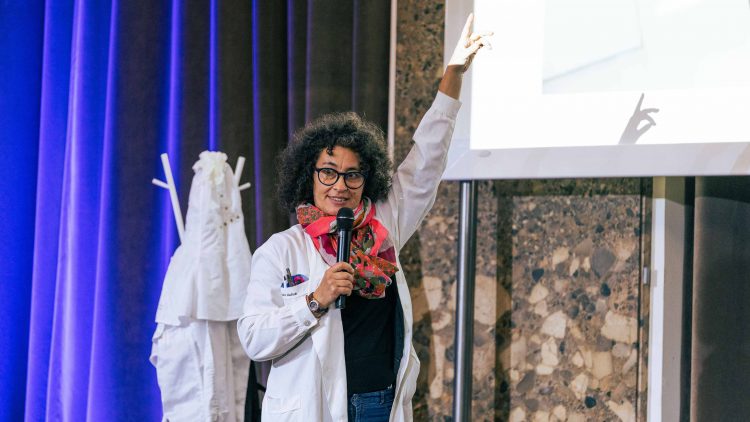
On 18 March, the Great Hall at Técnico – Alameda Campus hosted another “Explain it like I’m 5” talk, this time dedicated to mineral raw materials. Throughout the morning, Amélia Dionísio, a professor at Instituto Superior Técnico, Universidade de Lisboa, and researcher at Centro de Recursos Naturais e Ambiente (CERENA), talked with children about what connects everyday life, natural processes and engineering intervention.
“What are you wearing today?”, she asked. Children’s reaction is immediate: eyes drop to their clothes, they exchange glances with their classmates, and the first answers pop up – “jeans”, “cotton T-shirts”, “leather shoes”, “woollen coats”. Based on these observations, an initial distinction is made between the origin of materials: animal, plant and mineral.
“A raw material is something that comes from nature and that we use to make other things”, explains Amélia Dionísio. “Many of the things we use every day start as minerals found in rocks and soil. Others can be used again if we recycle them”.
The rocks laid out on the table take on new meaning. They are picked up, compared and analysed. “Rocks are formed by minerals that ‘get on well with each other’, which formed under similar conditions”, says the researcher. The distinction between rock and mineral becomes evident, leading to another question: how many minerals exist in nature? Answers range from tens to millions, but the actual number is approximately 4,500 known minerals, with only about “a dozen responsible for the majority of rocks”.
Throughout the activity, various examples illustrate and expand the explanation. Items such as coins, musical instruments, wind turbines and everyday infrastructure are highlighted as “being dependent on mineral raw materials”. This connection between objects and their geological origins becomes increasingly clearer, demonstrating the constant presence of geological resources in various contexts.
“And how can we find these materials?” the researcher asks again. The answer introduces the concept of ‘extraction work’. “Scientists and engineers use techniques to study what lies beneath the surface. Some are direct, others indirect, such as using waves to detect what lies underground.” The discovery is just one stage of the process. “To extract these materials, safety must be ensured and authorisation must be obtained. This extraction can occur in open-cast or underground mines”.
After extraction comes the processing stage. “What we extract is not a pure mineral”, she emphasises, also explaining the need for energy, water, industrial facilities and reagents to separate the desired mineral from the rock. “The role of a mining engineer is to identify the best methods for extracting rock and processing minerals while aiming to minimise energy consumption and waste.”
In the final stage of the session, the children are divided into two teams, assuming the role of “mining engineers” and face a challenge: to separate and organise, by colour, the pieces of two Lego cubes – one consisting of larger pieces, the other of smaller ones. As the time ticks away amid some commotion, different strategies lead to varying results, emphasising the “impact of fragment size on separation processes”.
The activity highlighted the efficient separation of different materials. “Throughout this process, it is important not to overlook people’s safety and the protection of the environment”, emphasises Amélia Dionísio. “Everything we use has a source and makes an impact. Engineering plays a vital role in how we manage these resources”.
The “Explain it like I’m 5” talk series aims to introduce younger audiences to research topics and engineering areas taught at Técnico. The programme runs until May 2026, with new sessions dedicated to different fields of knowledge:
- 29 April 2026, 10 a.m. – “The Universe – Is it infinitely large or infinitely small?” – Pedro Abreu (LIP)
- 13 May 2026, 10 a.m. – “Why are soap bubbles round?” – Hugo Tavares (CAMGSD)
Previous talks:
8 October 2025, 10 a.m. – “How does a satellite work? – João Paulo Monteiro (ISR-Lisboa)
“How does a satellite work?”: Técnico opened its doors to the curiosity of young children
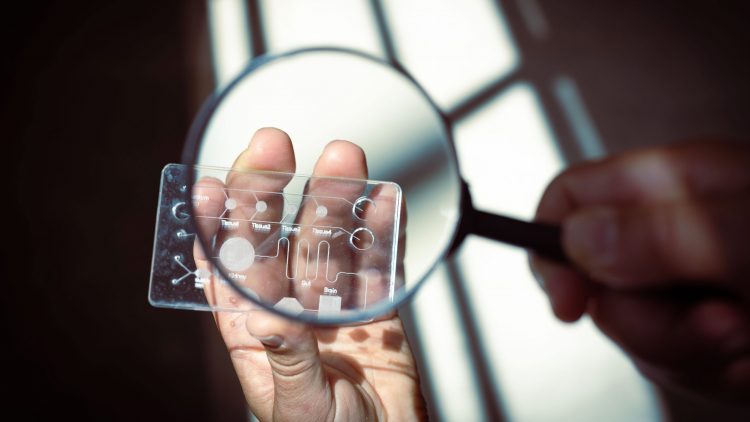
12 November 2025, 10 a.m. – “How does a laboratory that fits in the palm of your hand work?” – Vânia Silvério (INESC-MN)
A laboratory that fits in the palm of your hand: children discover micro-scale science at Técnico
10 December 2025, 10 a.m. – “What happens to toilet water?” – Ricardo Santos (LAIST)
4 January 2026, 10 a.m. – “What is radiation used for?” – Joana Madureira (C2TN)
6 February 2026, 10 a.m. – “Did you know that there are cities where every drop of water counts… and others where every drop is wasted?” – Filipa Ferreira (CERIS)
“Every drop has a path”: a journey through the water cycle explained to children at Técnico