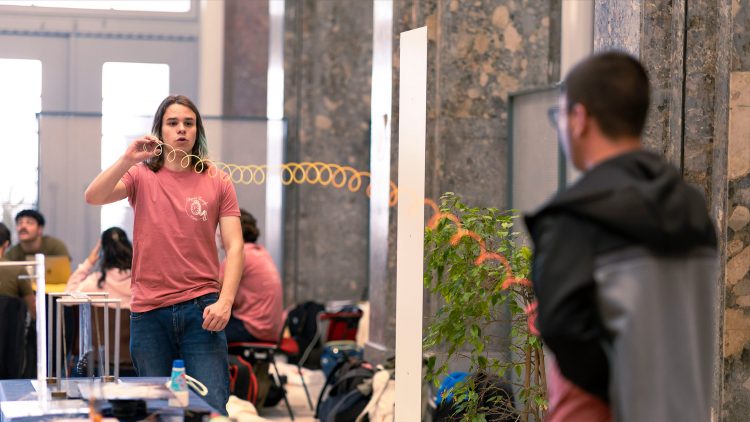
“When we release one of the spheres, we are transforming potential energy into kinetic energy”. The explanation accompanies the rhythmic sound of the metal spheres colliding in a Newton’s cradle installed in the Main Atrium at the Alameda campus of Instituto Superior Técnico, Universidade de Lisboa. Over the course of five days, from 20 to 24 April, more than two thousand basic and secondary school students visited Técnico to participate in Physics Week, organised by the Department of Physics at Instituto Superior Técnico (NFIST).
The journey unfolds from station to station in an environment filled with a continuous flow of visitors, with experiences that never repeat in the same way. At one of the stations, a swivel chair serves as a vantage point. Seated there, Gabriela, a 10th-grade student, holds two 2-kg weights with her arms outstretched. Rodrigo Costa, an Engineering Physics undergraduate student at Técnico, starts the rotation. “Now bring your arms closer to your body”, he asks. The movement accelerates, eliciting immediate reactions. “When the mass is farther from the axis, the moment of inertia is greater”, explains Rodrigo Costa. “As you bring the weights closer, the moment decreases, and since angular momentum is conserved, the rotation becomes faster”. Nearby, some of her classmates mimic the gesture in the air, as if rehearsing the phenomenon before trying it themselves.
Further on, a bed of nails gathers a new circle of onlookers. A volunteer lies down cautiously, while Miguel Teixeira, also an Engineering Physics student, explains that “the applied force is distributed across multiple points of contact, reducing the pressure exerted on each one”. Next to it, a balloon confirms the principle: it remains intact on top of dozens of nails, but bursts upon contact with just one. “That’s why we don’t feel pain when we lie down on the bed of nails”, he concludes.
Elsewhere in the lobby, gravity takes visible form on an elastic surface. Marbles trace curved paths around a heavier sphere that distorts the fabric. “This blanket helps us visualise spacetime”, explains Matilde Falcão, a Técnico first-year student in Engineering Physics. “Larger mass bodies create greater curvature, which guides the movement of the others”. The explanation extends to black holes and the ‘event horizon’, where the curvature becomes extreme. “On Earth, the escape velocity is about 11 km/s. The greater the mass, the greater the velocity needed to escape its gravitational field”, adds Matilde Falcão, as a new marble alters its previous orbit.
“Showing the most enjoyable part of Physics”
In the Great Hall of Alameda campus, the lighting is dimmer and the focus shifts to a column of fire that reacts to sound. The flames oscillate to the rhythm of the music chosen by visitors, varying in height and shape according to the frequency of the sound wave emitted. Sara, a 9th-year student at Alfornelos Basic School, describes it as “the most memorable experience” of the tour. “The different sound frequencies determine distinct patterns in the flame’s behaviour”, the class is told, as each variation in the sound wave—with its compression and rarefaction zones —translates into its own unique mode of oscillation.
“It’s different to see and experience things firsthand”, says Rui, a secondary school student. “It helps us better understand what we learn in class and what we see on the board”. He admits that interacting with Técnico students influences “how I see the future”, even though he hasn’t yet decided what he wants to study in university.
For the teachers, attending Physics Week serves as an extension of the work done in the classroom. “These activities allow us to connect theoretical concepts to observable situations”, says the Physics and Chemistry teacher who is accompanying the 11th-grade class from António Damásio Secondary School. “The students interact with university students, ask questions, and see the practical application of topics that often seem abstract to them”.
Holding hands and forming a circle, a group of students anticipates what is to come. The Van de Graaff generator builds up an electric charge, and when the potential difference is established, the discharge runs through the group. The small shock triggers immediate reactions—laughter, surprise, and a brief lapse in concentration that quickly gives way to curiosity.
Throughout the week, Técnico students conducted demonstrations, provided explanations, and interacted with visitors, aiming to “show the most enjoyable part of physics”. According to Guilherme Ferreira, the event organiser, the goal is to create “mental bridges between concepts and the real world,” helping participants develop a “clearer understanding of how physical phenomena manifest in everyday life and in scientific development.”
At the end of the tour, the rhythmic and constant sound of the metal spheres once again stands out in the lobby. As new groups pass by, the gestures and explanations are repeated. Between one collision and the next, what was once fixed on the board now extends into space—and follows the visitors as they exit Técnico.