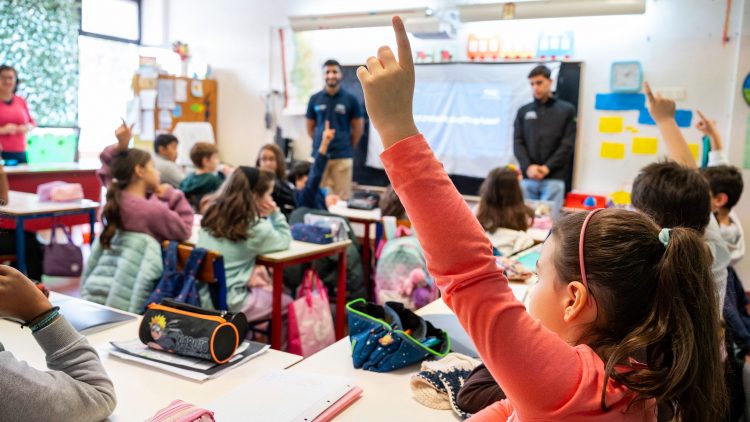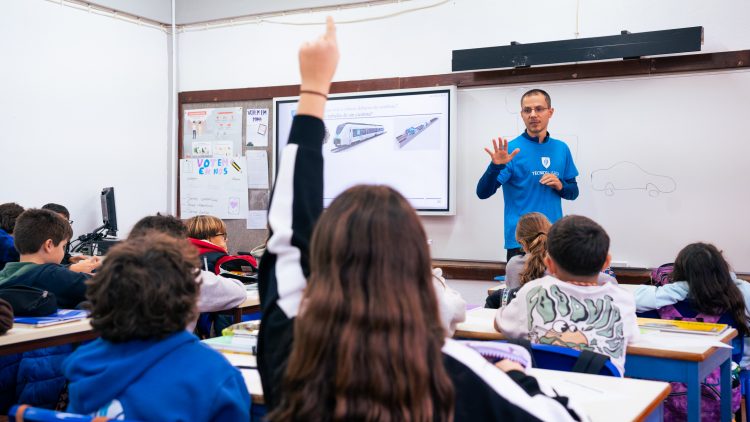
The week began with an object being passed from hand to hand in a 3rd grade class at Escola Básica Pintora Maluda, in Lisbon. “I can’t bend it!” exclaimed one student while holding a rigid and “surprisingly light” piece. It was carbon fibre, a structural component of the “most efficient car in Portugal,” developed as part of Projeto de Sustentabilidade Energética Móvel (PSEM). The small piece sparked a conversation about materials, electric energy, and efficiency. Amid questions about solar panels, batteries, and the forces that make a vehicle move, the class collectively embraced a clear idea: “To help protect our surroundings and reduce our carbon footprint”.
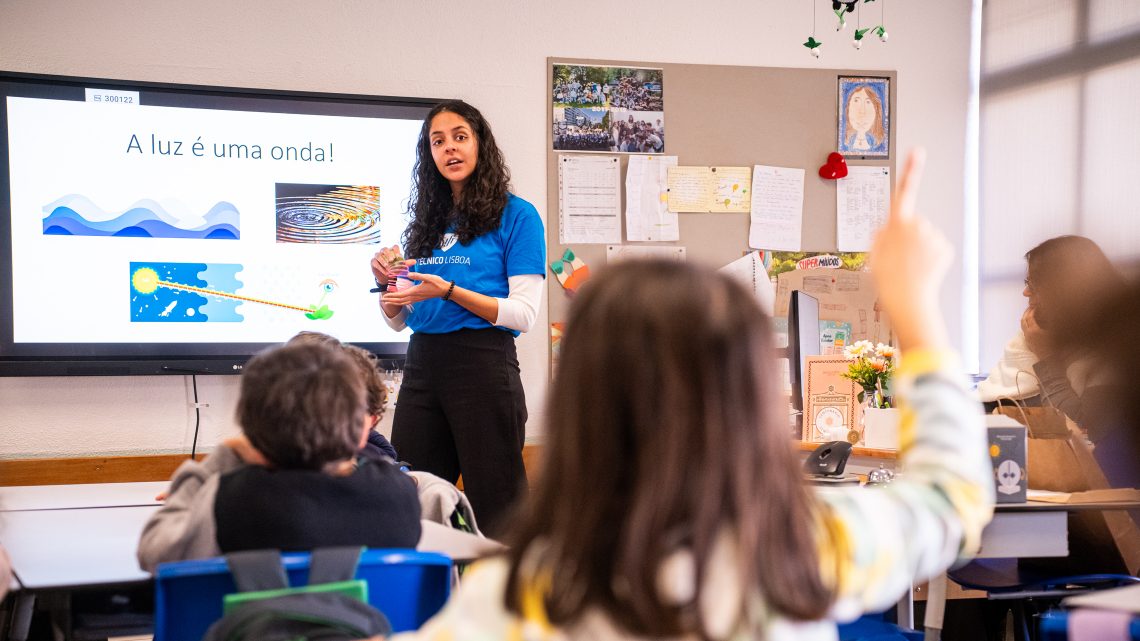
The activity was part of the 2nd edition of the initiative “Engenharia e Ciência vão à Escola”, promoted by Instituto Superior Técnico during Science and Technology Week. Between 24 to 28 November, more than 40 interactive sessions were held in schools across Lisbon, Loures, and Oeiras, bringing research closer to basic education and demonstrating how scientific phenomena and engineering processes emerge in everyday objects.
At Escola Secundária D. Dinis, light took on several roles. Mário Berberan e Santos and Manuel Prieto, professors at Técnico and researchers at the Institute for Bioengineering and Biosciences (iBB), entered the classroom with a projected rainbow, a magnesium strip, and an ultraviolet (UV) lamp, guiding the 9th grade students through examples of phenomena that exist even when they are not visible. When the UV light was switched on, tonic water glowed blue, counterfeit banknotes revealed hidden markings, and it became evident that olive oil also fluoresces due to the presence of chlorophyll. “Light tells chemical stories,” explained one of the researchers, linking the topic to fireflies and bioluminescence. At the end of the session, the class teacher, Filipe Costa, emphasised the importance of the demonstrations: “We were all amazed. It is sessions like this that plant a seed of scientific curiosity in the students”.
In the neighbouring classroom, the focus was on electromagnetic radiation. Bernardo Galego, researcher at the Instituto de Engenharia de Sistemas e Computadores – Investigação e Desenvolvimento em Lisboa (INESC-ID), explained how simulations and safety limits are measured in everyday life. “My job is to ensure that the values around us are safe,” he stated, emphasising that the physical effects “depend on the duration and energy of radiation exposure”.
The journey continued in Loures, where 1st grade students at Escola Básica da Bela Vista travelled to space with António Gomes, researcher at the Laboratory of Instrumentation and Experimental Particle Physics (LIP). Equipped with a telescope, he explained the BepiColombo mission, which has been travelling for about eight years towards Mercury. The relative size of the planets, Mercury’s orbit, and the role of satellites prompted a rapid succession of questions and enthusiastic answers from all corners of the classroom. “Do you have to leave already?” was heard at the end of the presentation, provoking shy laughter that kept the energy of the session alive.
Back to Lisbon, another classroom was filled with a familiar set of objects, from bicycles to Lego pieces and coloured pencils, which served as the starting point for the session “How are things made?”. Inês Matias Almeida, from Mechanical Engineering Institute (IdMEC), explained to 4th grade students at Escola Básica O Leão de Arroios how “different machines and techniques allow the production of materials and structures”. When discussing airplane construction, the figure that captured everyone’s attention was immediate: “about one million screws.” Imagination took over the discussion, and students shared ideas about what they would like to build in the future. “It is possible to manufacture anything; if not in one way, then in another,” emphasised the researcher. For the teacher, Célia Nunes, the impact of the activity was clear: “Even the most introverted students participate and come up with incredible ideas. Last year, the session was very well received, and the students asked me for more”, she shared.

Sustainability took on new forms at Escola Secundária D. Filipa de Lencastre where Janice Lopes from Centro de Ciências e Tecnologias Nucleares (C2TN), brought 5th grade students examples of how to “turn grape pomace into scientific solutions”. Amid phenolic compounds, cosmetic applications, and ideas for agriculture, the students observed samples revealing compounds and pigments. “Colours are like a secret language of plants,” Janice explained, while the class drew parallels with everyday fruits. “Does that mean bananas have carotenoids?” asked one student, applying the concept they had just learned.
The week concluded in Oeiras, where the light was once again the main focus, this time as a ‘weapon of encryption’. In front of 3rd grade students at Escola Básica António Rebelo de Andrade, Beatriz Costa, a PhD student and researcher at the Center of Physics and Engineering of Advanced Materials (CeFEMA) showed how light patterns can hide information. Using specific filters, she revealed hidden words and challenged the class to decode others: “I do the science of hiding messages through light polarization,” she explained, while the students rotated their “spy filters” searching for new signals.
Over five days, the connection between schools and research was fostered through objects passed from hand to hand, colours that appeared, questions voiced, and small phenomena that gained meaning the moment they were closely observed. Nearly 60 researchers and students from Técnico engaged with more than a thousand students from 1st to 9th grade, where science was the starting point and curiosity knew no bounds.
Report from the 2024 edition: “Engenharia e Ciência vão à Escola”: Young people from Lisbon, Loures and Oeiras explored the future of science with the Técnico community.
Photogallery (soon).