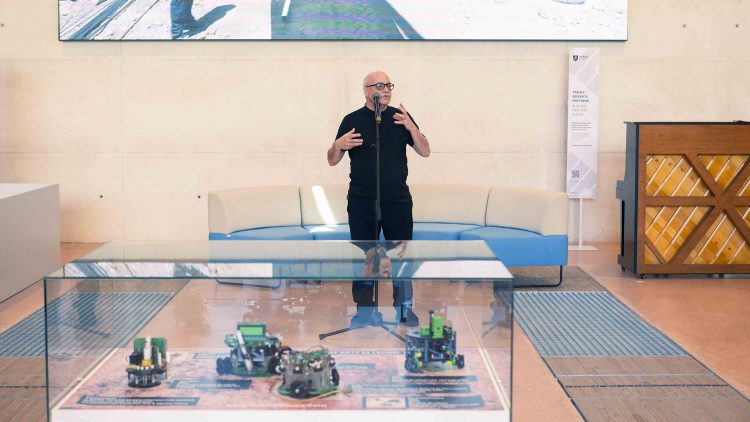
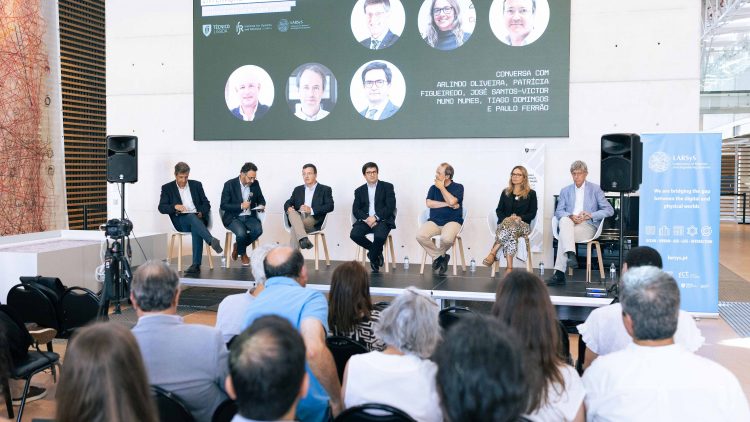
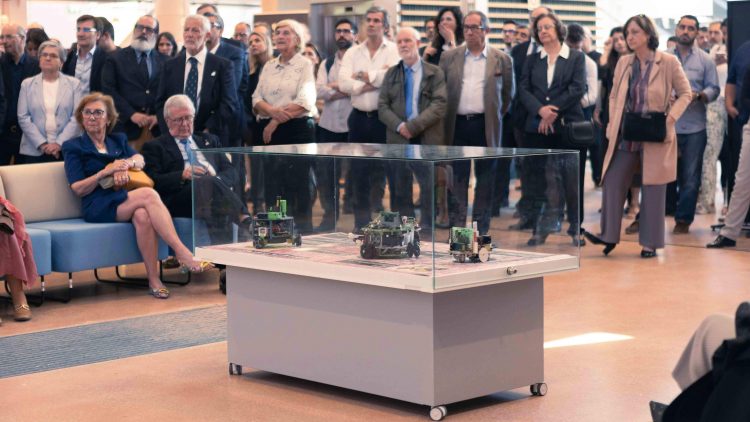
From the bottom of the sea to agricultural soils, including sensors, satellites and decision support systems, real-world applications of Artificial Intelligence (AI) were discussed at Técnico Innovation Center powered by Fidelidade, on December 12, 2025. This event was part of a series of talks titled “Artificial Intelligence in Interaction with the Physical World”, organised by the Institute for Systems and Robotics (ISR-Lisboa/LARSyS), bringing together researchers from Técnico and professionals from the sector around the theme “Energy, Water, the Environment and Agriculture”.
Research into cooperative marine robotics conducted at Técnico significantly contributed to the conversation about AI’s application in complex natural environments. António Pascoal, a researcher at ISR-Lisboa/LARSyS and former professor at Técnico, highlighted the challenges of operating in poorly structured areas: “We are dealing with large areas where it is necessary to process images and large amounts of data to infer the state of the environment.’ Some examples highlighted were the mapping of radioactivity on the seabed and the monitoring of fauna, which require advanced Artificial Intelligence tools “capable of maximising the available information and supporting real-time decision-making, which are fundamental to the study of ecosystems”.
The topic of environmental monitoring was further explored by Alexandre Bernardino, a professor at Técnico and a researcher at ISR-Lisboa/LARSyS. He characterised AI as a “relevant factor” for key sectors of the Portuguese economy. “Economic progress is made when action is taken in the physical world”, he said, highlighting AI’s role in integrating data from sensors, satellites and historical data (to identify past patterns). According to the researcher, the challenge is not limited to analysis, but extends to intervention and “the need to encourage people to use Artificial Intelligence”, namely through the assessment of uncertainty, which is still under development.
The link between technology and agricultural practice was brought up by João Coimbra, CEO of Quinta da Cholda, who shared his decades of experience investing in data collection and interpretation. “To produce a kilo of corn, I make about a hundred decisions”, he said, explaining that current agricultural management is based on continuous measurements of water, energy, and prices. According to the farmer, the creation of a data series reduces errors and improves decision-making. “The classic agronomic model is becoming obsolete”, he stated, also noting that the future will involve combining different technologies to respond to the current challenges of agriculture.
This combination was at the core message of Tiago Morais, founder of VirtuaCrop, a member of the IST Spin-Off Community, who presented solutions based on combining traditional physical modelling with machine learning. “Our goal is to be proactive rather than reactive”, he explained, pointing to the possibility of estimating soil properties using indirect methods and anticipating decisions before harvest. The Técnico alumnus stressed that the main challenge for the sector “is not the amount of data available, but its effective use for decision-making”, and recognised the need to overcome the perception of AI models as black boxes in order to strengthen users’ confidence.
The session concluded with insights from Tiago Domingos, a professor at Técnico and a researcher at the Marine, Environment and Technology Center (MARETEC), who placed AI within the context of economic growth and sustainability, noting that “economic growth has historically been based on the massive use of energy”. He characterised the current technological transformation as “a fourth industrial revolution strongly linked to the physical world”. In this scenario, he said, AI could be decisive in reducing environmental impact and supporting a transition to what he described as potentially becoming “the first sustainable industrial revolution”.
The series of talks “Artificial Intelligence in Interaction with the Physical World” will return in 2026 with new sessions dedicated to analysing practical applications of AI in different sectors and studying the challenges associated with its use in the physical world:
- 23 January 2026 – “Artificial Intelligence in Healthcare: Personalised Diagnosis, Treatment and Care”
- 13 February 2026 – “Ethics and Social Responsibility of AI”