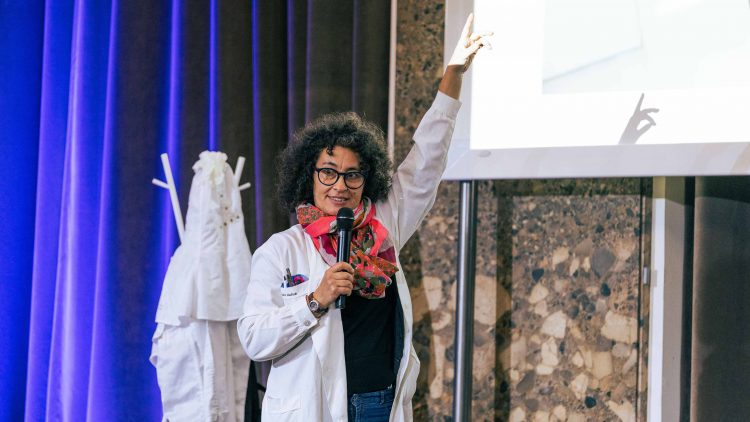
The phrase “only toilet paper should go in the toilet” was the most commonly heard during the third science talk “Explain it like I’m 5”, held on December 10, 2025, in the Great Hall of Técnico – Alameda campus. This advice, emphasised throughout the event, served as a starting point for a journey led by Ricardo Santos, a researcher at the Department of Nuclear Sciences and Engineering (DECN) – Instituto Superior Técnico, the Civil Engineering Research and Innovation for Sustainability (CERIS), and deputy director of the Water Laboratory at Instituto Superior Técnico, who challenged the younger audience to discover the invisible journey of water after it is flushed down the toilet.
Guiding the children from everyday objects to the underground pipe system that receives wastewater from homes, Ricardo Santos described “a journey that begins in the flush”, explaining that the pipes increase in size as they collect flows from various homes and carry all the water to a common point.
The “water factory”, which is the name given to the Wastewater Treatment Plant (WWTP), emerged as the natural destination for this water journey. The researcher explained that, upon arriving at the “factory”, the water undergoes processes that first remove the larger residues and then the finer particles, such as sand and sludge. “We separate solids from liquids”, he described. This is followed by biological treatments, secondary settling, filtration and, finally, disinfection, which can take a few hours or days, depending on the volume of water and the size of the facility, until “the water is clean”. The researcher also stressed that this is a “standard treatment”: the order and combination of processes may vary depending on the specific operation of each WWTP, but the ultimate goal remains the same – “to ensure that the water can be safely reused”.
To emphasise the global relevance of sanitation, the researcher presented data from the United Nations, noting that “427 million children do not have access to toilets in schools”. He also recalled World Toilet Day, celebrated on 19 November, challenging the audience to reflect on inequality in basic sanitation access. “In many regions, the lack of sanitation has serious consequences, so it is important that these children also have access to clean water”, he argued.
The explanations aroused the children’s curiosity. “How do you know that the water is really safe to drink?” asked a child in the back of the room. Ricardo Santos explained that, before reaching people, the water is analysed – both at the entrance and exit of the infrastructure – to ensure that it meets all quality parameters. The answer prompted the next question: “Do we also drink the water that comes from the toilet?” The researcher explained that treated water can be reused for irrigation, street washing, car cleaning, or industrial processes, but water for human consumption follows its own distinct systems.
The narrative then moved on to the final destination of treated water: gardens, public spaces, vehicles and, in some cases, industrial processes such as beer production. The children’s surprise at realising that water could be reused was one of the most vivid moments of the session. At various points throughout the session, the researcher emphasised that “wastewater should be seen as a treatable and reusable resource” and warned of the impact of medicines or inappropriate objects in the toilet, which can compromise the functioning of infrastructure and affect rivers and seas.
The session ended with a mental image of clean rivers and beaches, allowing the participants to reframe their understanding of the water cycle: from the toilet to the pipes, from the pipes to the WWTP and from the WWTP back to the environment. This complete water journey highlighted how sanitation systems operate and reinforced the central idea of the session: the urban water cycle relies on complex infrastructure, as well as on simple everyday choices, whose impact extends far beyond each toilet flush.
“Explain it like I’m 5” will return in 2026 with new science talks dedicated to presenting different research areas at Técnico:
- 14 January 2026, 10 a.m. – “What is radiation used for?” – Joana Madureira (C2TN)
- 6 February 2026, 10 a.m. – “Did you know that there are cities where every drop counts… and others where every drop is wasted?” – Filipa Ferreira (CERIS)
- 18 March 2026, 10 a.m. – “Where do the things we use to make other things come from?” – Maria João Pereira (CERENA)
- 29 April 2026, 10 a.m. – “The Universe – Is it infinitely large or infinitely small?” – Pedro Abreu (LIP)
- 13 May 2026, 10 a.m. – “Can music be measured?” – Diogo Oliveira e Silva (CAMGSD)
Previous talks:
8 October 2025, 10 a.m. – “How does a satellite work?” – João Paulo Monteiro (ISR-Lisboa)
News published on the Técnico website:“How does a satellite work?”: Técnico opened its doors to the curiosity of young children
12 November 2025, 10 a.m. – “How does a laboratory that fits in the palm of your hand work?” – Vânia Silvério (INESC-MN)
News published on the Técnico website: “A laboratory that fits in the palm of your hand: children discover micro-scale science at Técnico”