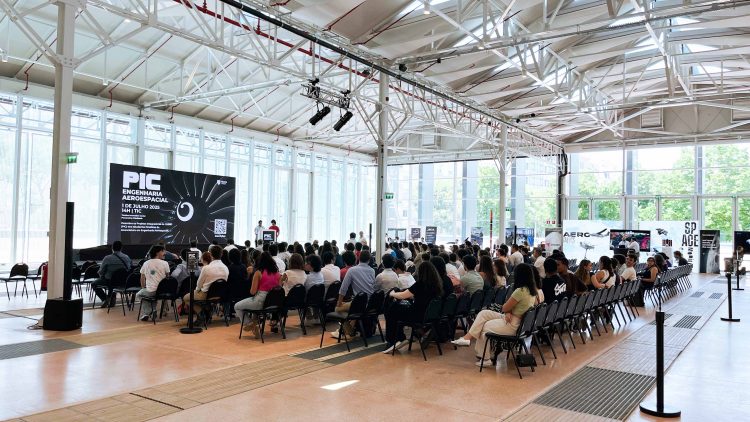
Some affectionately call it the “PIC at the TIC”. They are referring to the First-Cycle Integrative Projects (PIC) at the Técnico Innovation Center powered by Fidelidade. PICs are developed by aerospace engineering undergraduate students at Instituto Superior Técnico, Universidade de Lisboa.
The event took place on 23 June and marked a milestone in these students’ graduation, bringing together the skills acquired over the past few years to solve real-world problems as part of the First-Cycle Integrative Project curricular unit. The venue was filled with finalist students, professors, scientific posters showcasing the developed projects, and representatives from Aerospace companies (CEiiA, GeoSat, and Beyond Gravity).
“What you have achieved here is extraordinary”, said Pedro Amaral, the Vice-President of Técnico for Corporate Interface, Innovation and Entrepreneurship, also emphasising that developing these PICs “is no child’s play, nor is it mere experimentation – you have really rolled up your sleeves and worked hard”. “The students”, he added, “should leave this event with lasting memories of the quality and joy that permeate these projects, as well as an understanding of the impact they have made within Técnico. It is you who are the very heart of the School”.
The coordinator of the Undergraduate Programme in Aerospace Engineering, João Melo de Sousa, described the event as the culmination of the investment, dedication, and commitment of the Aerospace Engineering students, in a “demanding and prestigious” field.
Once the opening speeches concluded, Afzal Suleman, the curricular unit professor, reminded everyone that “the show must go on,” announcing the start of the PIC presentations. He added, however, that he had received several emails emphasising the importance of concluding the event on time, as the national football team would be playing against Uzbekistan at 6 p.m., on US soil.
During a break to look at the scientific posters displayed around the venue, which described the projects presented that afternoon in greater detail, student Joana Pereira explained that her group “aimed to integrate various skills and knowledge acquired throughout their degree”, helping them to “design projects from scratch” – “I feel much more confident about developing ideas”, she said.
Rodrigo Gonçalves is a student at Técnico and the Portuguese Air Force. For him, the PIC is a valuable asset in his academic journey, since “after graduating and starting to work in this field, there will be many practical elements essential to my success”, which he had the opportunity to practice during the development of his team’s project.
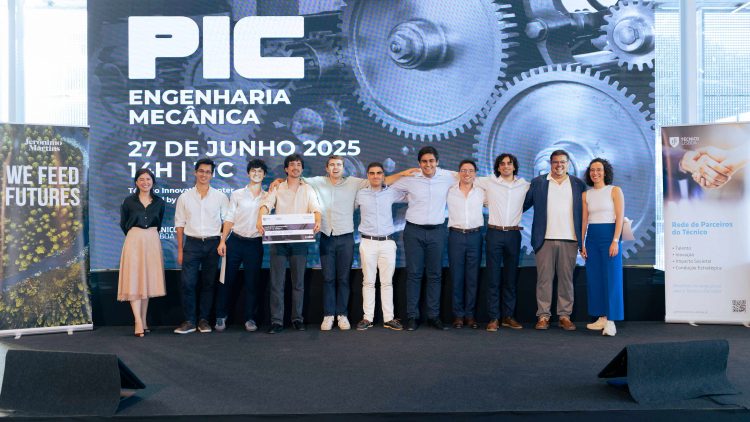
Once the introductions were made, the prizes were awarded (worth 1,250 euros for each winning group) and the final photos of the participants were taken, the event’s punctual schedule proved beneficial – the big screen on stage began broadcasting the match between the national football team and Uzbekistan, just as Portugal scored its first goal in the game. With the Técnico Innovation Center filled to capacity, celebrating Cristiano Ronaldo’s goal at the stadium in Houston, the coincidence seemed almost deliberate – that very city has a rich history as a mission control hub for NASA, providing these aerospace engineering students with an additional joy associated with the Texan town that has made the whole world look to the sky.
List of PICs submitted and winners
‘Satellites’ category
Winners: Ocean Eye – Red tides and microplastics – two major threats to ocean conservation. The Ocean Eye satellite detects the chemical signature of invasive algae and plastics, enabling a faster response in areas affected by these biological crises.
- Members of the winning team – Francisco Silveira, Matilde Massa, Joaquim Menezes, Tomás Teixeira, Duarte Guerreiro, André Rodrigues, João Santos, Francisco Falcão and Carolina Araújo.
Anzol-01 – A 70x70x60 cm satellite designed to capture and remove space debris, thereby protecting space missions from collisions with such debris.
CoastSat-AI – A 26x26x23 cm CubeSat equipped with on-board artificial intelligence to interpret data collected along the European coastline, the Canadian western coastline, the South American western coastline and the Philippines coastline. It captures high-definition images to monitor these coastal regions, with the aim of facilitating ocean conservation.
Earth–Mars Communications Satellite – A solar conjunction between Earth and Mars prevents adequate communications between equipment on the two planets. This satellite is proposed as a solution to this problem, acting as a relay for telecommunications between the two celestial bodies.
‘Satellite Launchers’ category
Winners: HERMES SOTER – What if astronauts were stranded at the International Space Station due to a fault with the equipment needed to return home? This system proposes an alternative method for astronauts to escape and survive re-entry into Earth’s atmosphere in catastrophic spacecraft failure scenarios.
- Members of the winning team – Abhishek Arvindbhai, Beatriz Dinis, Maria Maia, Filipe Vieira, Dominique Pinhel, Joana Basso, Tomás Gonçalves, Diogo Cinturão and Miguel Gonçalves.
Hades Mission – An air defence system against aircraft, drones, ballistic and cruise missiles, aimed at developing national and European defence autonomy.
Esperança-I – A launch vehicle to be deployed in Santa Maria (on Portuguese territory) that places satellites at an altitude of 800 km in low Earth orbit.
Stardust – A satellite launcher in low Earth orbit, which is itself launched from an aeroplane, thereby avoiding the problems associated with launching satellites from the Earth’s surface.
‘Unmanned Aerial Vehicles’ category
Winners: NEST – Seeking to resolve mobile network failures during disaster situations (with reference to Storm Kristin), NEST proposes a swarm of intelligent drones capable of providing emergency telecommunications coverage to affected areas (for example, just 12 of these devices would be sufficient to cover the Castelo Branco district).
- Members of the winning team – Alexandre Marques, Ana Leonor Dias, Constança Caçador, Filipa Fernandes, José Bernardo, Mariana Patracôlo, Matilde Lourenço and Rafaela Alves.
Corvus-X8 – A drone for rapid response to medical emergencies, carrying a first-aid kit to assist with cardiac arrest, haemorrhages or anaphylactic shock, to be used by the person who called the emergency services while awaiting their arrival.
Omniscan – A swarm of drones for humanitarian missions (such as mine detection), rather than missions carried out by a single aircraft, to allow for greater operational flexibility.
Sky Hunter – A defence drone designed to intercept and neutralise attack drones, equipped with radar and an infrared camera, among other equipment for environmental reconnaissance.
‘Urban Air Mobility’ category
Winners: ModulAir – A modular, autonomous aircraft that can be used as an air ambulance, a rescue vehicle with a winch, a cargo carrier or a passenger transport.
- Members of the winning team – André Delgado, Catarina Calçada, César Correia, Dinis Costa, Diogo Dias, Francisco Peça, Gabriel Pinho and Mafalda Novais.
Island Hopper – A six-rotor aircraft designed for the rapid transport of people between the Spanish Balearic Islands (in particular, Mallorca, Menorca and Ibiza).
SkyMed – An aircraft for the transport of emergency patients, designed to replace helicopters, with a total of 10 blades integrated into the wings, ensuring the safety of patients and medical staff during vertical take-offs and landings.