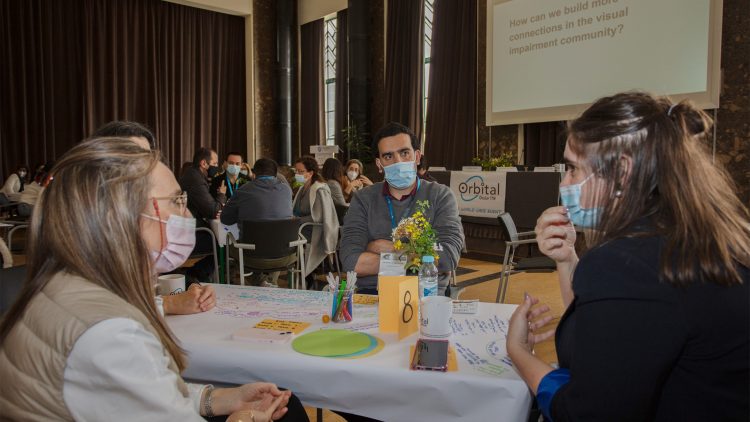
Students, professors and industry representatives gathered to reflect on the gap between higher education and the job market at the latest edition of LEoE (Local Event on Education), an event organised by BEST Lisbon, the local chapter of BEST – Board of European Students of Technology, which took place on 11 May at the Técnico Innovation Center powered by Fidelidade.
The programme featured a panel discussion comprising Maria Ribeiro Soares, founder and CEO of Immersiv Studios; Miguel Cacho Teixeira, President of the Pedagogical Council at Instituto Superior Técnico; Fernando Almeida Santos, President of the Ordem dos Engenheiros; and Pedro Neto Monteiro, representative of the Lisbon Academic Federation and former President of Técnico Students’ Union (AEIST). Topics discussed included artificial intelligence in education, the development of soft skills, and bringing higher education closer to the job market.
Pedro Neto Monteiro emphasised that Técnico has a “strong ability to prepare students for the job market”, particularly through its complementary pathways. He also mentioned that higher education institutions benefit from closely aligning with the professional context, stating, “Técnico is quite well adapted, but this is not the case for all institutions”. Miguel Cacho Teixeira highlighted that Técnico is transitioning “from abstract learning to learning by doing”, considering that partnerships with companies and the university’s projects make “all the difference”.
The adaptation of education to the growth of artificial intelligence and the digital transition was also discussed. Given that AI should be used in engineering as a tool, Fernando Almeida Santos acknowledged that it can improve engineers’ work, whilst at the same time, engineers are needed to ‘improve’ the technology itself. ‘Engineers always take precedence over AI’, he emphasised. He highlighted the need for increased investment in the digital aspects of engineering courses to make these programmes more “attractive”.
For Miguel Cacho Teixeira, the integration of artificial intelligence is not the real “challenge”, but rather the need to “redefine” the “professions of the future”. The professor also stressed that the “ability to design, solve problems and take responsibility” remains a human trait.
The role of academic institutions in developing soft skills and entrepreneurial skills was another topic under discussion. Maria Ribeiro Soares believes that the “solution” for developing skills valued in the job market, such as communication, should not involve simply “adding” more curricular units. As an industry representative, she suggested that these skills can be developed through extracurricular activities, arguing that there is “available space” for this within the School.
Vicente Gomes, a fifth-year student of Computer Science and Engineering, stressed the importance of “broadening horizons” beyond academics. He emphasised the need to understand what “sets students apart” in the eyes of employers beyond their grades. “I think events like this, which promote the exchange of ideas and interaction, are very helpful and important for developing these kinds of soft skills”, he said.
Beatriz Morais, a final-year master’s student in Biomedical Engineering, described the discussion about integrating into the industry and the ‘gap’ between companies’ expectations and the skills students acquire as ‘crucial’. She found the speakers insightful in helping her understand the necessary attributes to join a team. With her experience in various projects and involvement in AEIST, she noted that it is “easy” to participate in Técnico’s students’ organisations. “I think this is one of the things that sets Técnico apart from other universities because it provides us with these soft skills. While not directly part of our academic curriculum, Técnico indirectly offers us this development, partly through the support given to students’ organisations”, she explained.
“In the last edition we discussed the impact of LLMs, when there was a boom, and this year we decided to address this topic because we consider it quite relevant”, explained David Rodrigues, a master’s student in Biomedical Engineering and “Main Organiser” of BEST Lisbon. According to him, the “key point” of the discussion lies in “improving the education system” so that students “leave better prepared” for the job market. “The conclusions of the debate will be sent in a document to Técnico’s Pedagogical Council, so that we can implement what was discussed”, he concluded.
The programme also included a networking session between companies and participants and concluded with a talk by João Moita, a Técnico alumnus and CEO of Product Circle, as part of the celebrations for BEST Lisboa’s anniversary.