How can artificial intelligence, laboratory automation and autonomous experimentation accelerate the discovery of new materials? This was the question addressed by the AccelMAPs 2026 Training School, which brought together 84 participants from 19 European countries at Instituto Superior Técnico’s Loures Campus, from 18 to 21 May.
Over four days, 11 trainers shared their expertise with 73 researchers at different stages of their careers, who had the opportunity to explore emerging methodologies and technologies, from atomistic modelling to advanced materials characterisation, which are accelerating research in materials science and engineering for energy technologies.
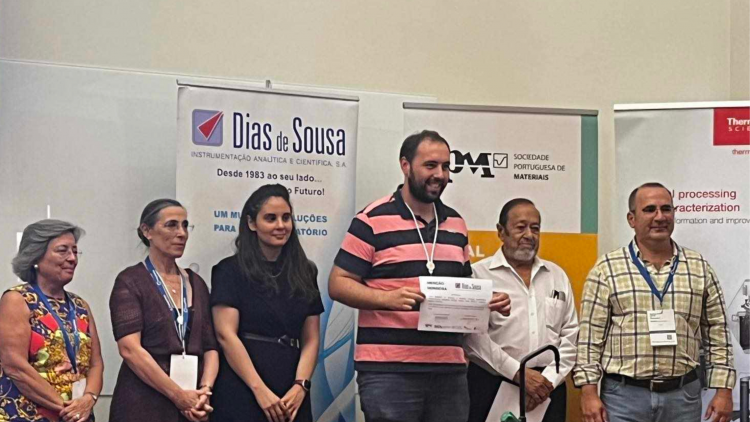
Among the participants were several PhD students from Técnico and other national and international universities, for whom the AccelMAPs represented an opportunity to gain a deeper understanding of the potential of these technologies in research. Beatriz Santos, a PhD student in Materials Engineering at Técnico, noted that “the prospect of carrying out research more rapidly, through automation and the efficient execution of complex tasks, seems both ambitious and realistic”.
The event was held within the framework of the EU-funded COST Action EU-MACE, which aims to build a research ecosystem centered on Materials Acceleration Platforms (MAPs)—highly automated scientific research systems that use artificial intelligence to enable the faster development of new materials compared to processes involving greater human intervention. These laboratory-based artificial intelligence agents thus serve as “assistants” to scientists, freeing them from more routine tasks and allowing them to devote more time to interpreting results and designing new experiments.
In addition to the lectures, the AccelMAPs school included the presentation of 30 posters and visits to the Accelerator Laboratory, the Helium Liquefier, IRIS (Ionising Radiation Facility) and the Cryogenics Building, which houses the Mössbauer Spectroscopy, Magnetometry (SQUID and VSM) and Electrical Transport Properties laboratories, fostering exchanges between researchers from different disciplines and countries.
During the opening session, Sawako Nakamae, Chair of the COST Action EU-MACE, highlighted the role of MAPs and explained that the school had been designed to demonstrate how tools such as simulation, artificial intelligence, automation and data science can support the transformation of conventional laboratories (legacy labs) into more integrated research environments. “Our aim is not only to develop MAPs, but also to understand how traditional laboratories can be transformed and integrated into these platforms in order to accelerate energy materials research across Europe”, she said.
The local organisation of the event was coordinated by three Técnico researchers, all of whom are also members of the COST Action EU-MACE – António Pereira Gonçalves, Ana Charas and Sandra Rabaça.
According to António Pereira Gonçalves, a researcher at the Centre for Physics and Engineering of Advanced Materials (CeFEMA), initiatives such as AccelMAPs are “essential for accelerating the development of new materials and sustainable systems”. Ana Charas, a researcher at the Instituto de Telecomunicações (IT), highlighted the integrated perspective of the technologies that are “shaping the next generation of smart laboratories”. Sandra Rabaça, a researcher at the Centro de Ciências e Tecnologias Nucleares (C²TN), stressed that the school helped to make the “concept of Material Acceleration Platforms” more tangible and to understand the evolution of laboratories towards “more integrated, autonomous and data-driven environments”.