The Instituto Superior Técnico, Universidade de Lisboa, once again welcomed secondary school students to present their projects at the final of the ‘FAQtos Award’, on 11 July, at Alameda campus. This year’s competition, which brought together 56 teams, involving 204 students, 47 supervising teachers, and representatives from 37 schools, invited participants to develop projects under the theme “Radiofrequencies in Action”, with complete freedom regarding the project format.
The winning team, Guarda-Rios, from Colégio Ribadouro in Porto, presented the “Projeto Guarda-Rios” (“River Guardians Project”). The students developed a low-cost, energy self-sufficient system for monitoring river water quality through a network of sensors capable of measuring physicochemical parameters in real time. The solution can identify potential sources of pollution and make the collected data available through an online platform, contributing to more effective water resource management.
Second place was awarded to VisionGlass, from Escola Secundária Francisco Franco, in Funchal, for the project “RFs in Skin Health Analysis and Monitoring”. The team developed an innovative prototype that combines radiofrequency technology, electronic sensors, artificial intelligence, facial recognition, and augmented reality to support skin health assessment and monitoring. Connected to a mobile application, the system analyses the skin in real time, identifies different skin conditions, and provides users with fast, secure, and personalised information.
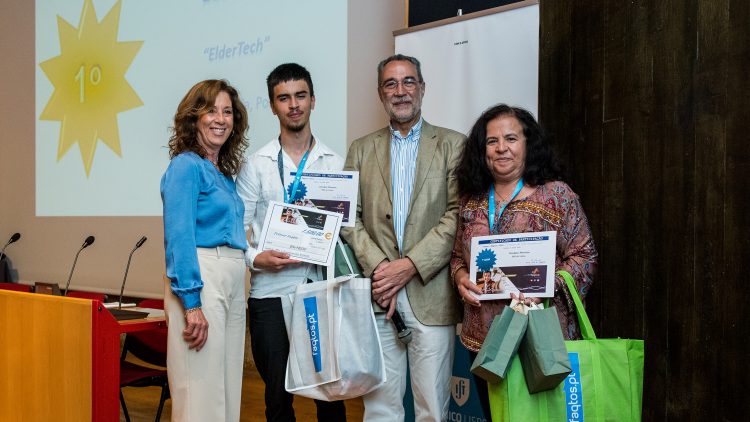
Third place went to The Pulse, from DIDÁXIS, in Vila Nova de Famalicão, for the project “SafeZone – Technology that Cares”. The students designed an intelligent location and active protection system for people living with Alzheimer’s disease and other forms of dementia. Using radiofrequency technology, GPS, and geofencing, the system relies on a wearable wristband that continuously communicates with a central unit, enabling real-time location tracking while enhancing users’ safety and independence.
The three teams were awarded prizes of €2000, €1500 and €1000, respectively.
According to Luís M. Correia, a Técnico professor and project coordinator, “this competition has encouraged students to engage in extracurricular activities while also involving their local communities”. He also highlighted the consistently high standard of entries submitted each year and emphasised Técnico’s role in supporting the initiative: “As a leading engineering school, Técnico’s involvement helps motivate students and encourages them to participate in the competition”.
The ‘FAQtos’ project aims to make reliable information on electromagnetic radiation in mobile communications publicly available, including topics such as electromagnetic waves, exposure limits, and other related aspects.
* This text was written in collaboration with the ‘FAQtos’ Project