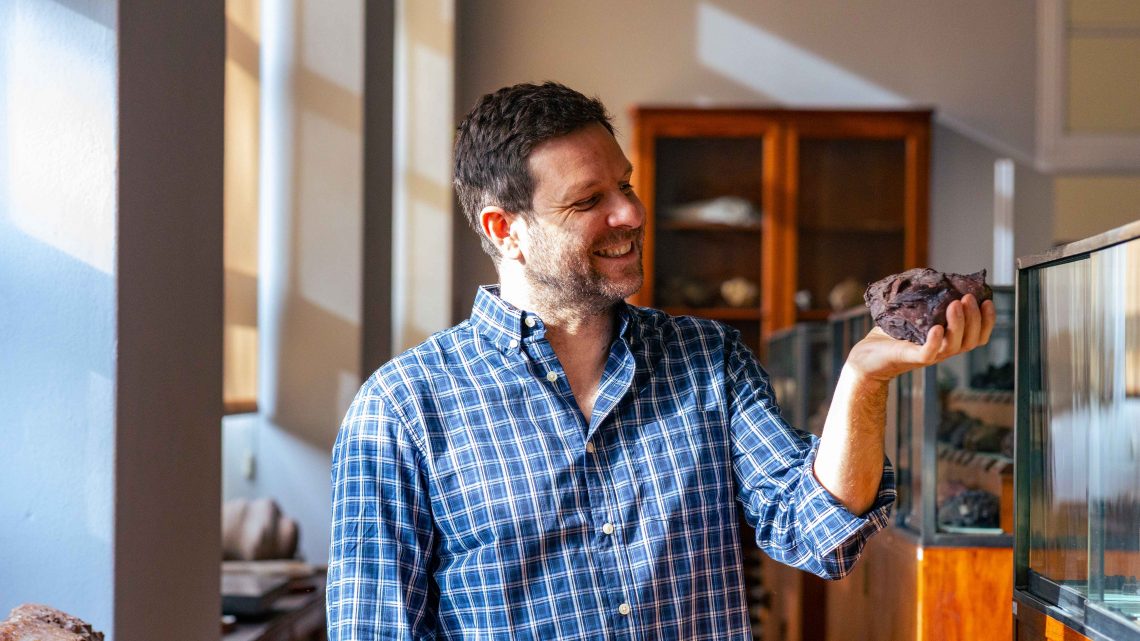
Ricardo Araújo, a professor at Instituto Superior Técnico and researcher at Centro de Recursos Naturais e Ambiente (CERENA), has been awarded a consolidator grant from the European Research Council (ERC). The €2 million in funding will allow the DAEDALUS Project to move forward. This proposal aims to determine when endothermy – the ability to maintain a stable body temperature – emerged in the evolutionary lineage linking dinosaurs to birds.
The project uses the thermo-motility index (TMI), a biophysical metric resulting from the analysis of the anatomy of the semicircular canals of the inner ear. These canals, which are important for balance and motion perception, have characteristics that can be quantitatively linked to body temperature. “The TMI will thus allow us to estimate body temperatures in extinct species from anatomical data present in fossils”, explains Ricardo Araújo. The central hypothesis of the project points to the emergence of endothermy during the Triassic period.
To validate TMI, the team will have to overcome “critical” data limitations. “Currently, viscosity data exists for only one species of bird (the pigeon) and no reptiles”, he points out. Among these is the systematic recording of the actual head movements of modern tetrapods, allowing the accuracy of the biomechanical models used to be assessed. The project also includes the study of the scale relationship between the bony labyrinth and the membranous labyrinth in different groups of vertebrates, in order to deepen knowledge about the soft tissues of the inner ear.
“Trying to determine the temperature of a dinosaur based solely on fossils is like trying to guess the top speed of an old car just by looking at its rusty bodywork. The DAEDALUS Project aims to reconstruct the engine (internal anatomy), analyse the fuel (endolymph viscosity) and see how the car behaved on the road (head movement) to find out how “hot” the engine really ran”, explains Ricardo Araújo.
Laboratory work will be enhanced by “developing specific surgical protocols and constructing a nanoviscosimeter, an instrument designed to measure the viscosity of endolymph” (a fluid found in the semicircular canals, which directly affects the calculations related to the index). In addition to the experimental and modelling studies, fieldwork is planned in Triassic formations, with the “aim of collecting fossils from basal groups of dinosaurs considered fundamental for testing the evolutionary hypotheses under investigation”, highlights Ricardo Araújo.
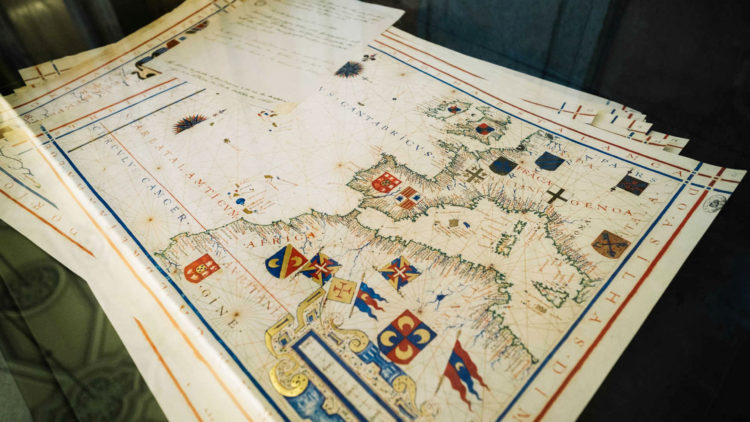
The team will also be joined by ENT specialists, veterinarians, biologists, and engineers, with further excavations planned in Portugal and Mozambique. “The DAEDALUS project will not only be trying to read an ancient map (the fossils); it will be building an entirely new “lens” (with a nanoviscosimeter and using AI algorithms) that will allow the scientific community to see physiological details that were previously invisible to the naked eye”, shares the researcher.
The ERC grant places Técnico “at the forefront of evolutionary biology and paleobiology worldwide, transforming it into a central hub of technological innovation applied to fundamental science”, turning it into an “engineering centre, where the tools to decode the physiology of the past are invented and validated for the whole world”, concludes the researcher.
The other grant to be awarded in Portugal goes to Juan Gallego, who will receive €2.1 million over the next five years to develop his research project – SELECT, at the Champalimaud Foundation. The project aims to uncover the neural mechanisms involved in learning and executing specialised movements. The researcher recently joined the Centre for Restorative Neurotechnology at Champalimaud Foundation, which comprises the Neuroscience of Disease Programme and the Neuroscience Programme.
On the European stage, the European Research Council awarded a total of €721 million to 281 selected researchers. In the field of life sciences, 732 applications were submitted, of which 83 obtained funding, resulting in an approval rate of 11%.
Miguel Castilho, a Técnico alumnus and a professor/researcher at Eindhoven University of Technology, was also awarded for a project that aims at cultivating blood-producing cells in the laboratory, which could reduce the reliance on voluntary donations for life-saving blood transfusions.
This is the 11th time that the ERC has distinguished Técnico researchers and the first time for CERENA. In recent years, Marco Piccardo was awarded an ERC Starting Grant in September 2024 for research into high-power laser-plasma interactions, and André Martins was awarded a Consolidator Grant in February 2023 to study artificial neural networks applied to natural language processing.
In 2022, Vitor Cardoso won his third ERC grant to study black holes, and Frederico Fiúza returned to Técnico to develop the XPACE project, also with funding from the European Research Council. In 2016, Patrícia Gonçalves received an ERC Starting Grant for her work on hydrodynamic limits and equilibrium fluctuations, and Luís Oliveira e Silva achieved his second ERC Advanced Grant, becoming the first Portuguese to reach this milestone. In the field of cloud computing, Rodrigo Rodrigues proposed a novel approach in 2012 to tackle previously unaddressed problems, which earned him an ERC Starting Grant.