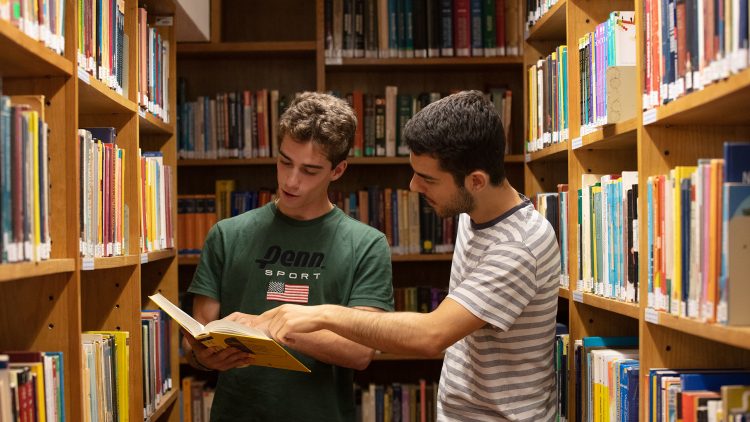
“Can I participate in a mobility programme if I’m behind on a curricular unit?” and “In double-degree programmes, where is the thesis defense held?” were some of the questions raised by students during the first “Master’s Programmes 101” session organised by the Student Support Office (NAPE). The event took place on 8 September in the AI Room at Alameda campus of Instituto Superior Técnico, Universidade de Lisboa, and focused on academic opportunities beyond the standard curriculum.
Participants included students newly enrolled in one of Técnico’s master’s programmes, as well as those still pursuing their undergraduate degrees and exploring their options for the coming years. Marta Falcão, who studied Engineering Physics in Porto, enrolled this year in the Master’s Programme in Engineering Physics at Técnico. She chose this university to delve deeper into the theoretical aspects of her field. “I realised that I wanted to pursue a more theoretical track, which is possible through the master’s programme at Técnico.” She also noted the university’s “prestige” and highlighted a curriculum that “better aligns with what” she is seeking.
Rita Salvador also enrolled in the same master’s programme this year. The two students initially attended the session with the goal of learning more about the PhD Fast Track, an optional pathway for undergraduate and master’s students with high academic performance who wish to pursue doctoral studies. However, they ended up discovering other opportunities that piqued their interest. “We were curious about the PhD Fast Track, but what really caught our attention were the mobility programmes, and I think they’ll be more useful to me now, so I’m going to look into them,” said Marta Falcão.
Rita Salvador found the introduction of Minors particularly interesting. This option allows students to supplement their master’s programme curricula with specific curricular units in a chosen field. “It was very helpful in every way. I didn’t know there were so many options.” She also mentioned that she had previously tried to enrol in a Minor but missed the registration deadline. “Now things are much clearer on that front,” she added.
The session was also attended by undergraduate students who are beginning to consider their different options for the future. This is the case for Guilherme Lourenço, Shanila Assane, and Damien Kosta. Guilherme Lourenço, a third-year Chemical Engineering student, had “some uncertainty regarding minors and extracurricular activities,” while Thamirez do Rosário, a final-year student in the Undergraduate Programme in Mining and Energy Resources Engineering, is considering participating in an exchange programme during her master’s degree. Damien Kosta, also a student in Mining and Energy Resources Engineering, is considering pursuing a double degree, which provides students with the opportunity to earn two diplomas—one from Técnico and the other from the foreign institution where they will complete part of their studies to fulfill the requirements for their degree.
Domingos Júnior, a civil engineering undergraduate student, was looking for more information about international mobility programmes and discovered the SMILE programme, which facilitates student exchanges between the European Union and countries in Latin America and the Caribbean, with academic recognition. “I was interested in that, and I’m going to try to apply and see how it goes,” he said.
According to Filipe Pereira, a biomedical engineering undergraduate student and a member of NAPE for about a year, the main difference between “Master’s Programmes 101” and the welcome sessions lies in their purpose. “Our goal with this ‘Master’s Programmes 101’ session was to introduce students to the various opportunities available, not necessarily limited to classes, that is, all kinds of experiences, such as mobility programmes, for example, ranging from Erasmus to longer-term experiences, such as the double-degree programme.”
In addition to these programmes, issues related to master’s theses were also discussed, and various options for pursuing an academic path were presented, including internships at companies and multidisciplinary projects, such as Capstone. “Capstone is a very innovative and recent project at Técnico, and I think it’s very important for us to make all these opportunities known, so that students know that the master’s programme can offer many experiences that go far beyond what they’ll study in class”, added Filipe Pereira.
The session also addressed the possibility of granting academic credit for extracurricular activities undertaken by students. “Many students end up participating in these activities simply for fun and to learn something new within their areas of interest. They can actually put this to good use in their degree programme”, he explained.
The first edition of “Master’s Programmes 101” was held in Portuguese. A second session, in English, is planned for international students. The date will be announced in the coming weeks via email. For any additional questions, interested parties can contact NAPE.
Applications for the 3rd call of Master’s Programmes (2026/2027) are open from 9 to 13 September.