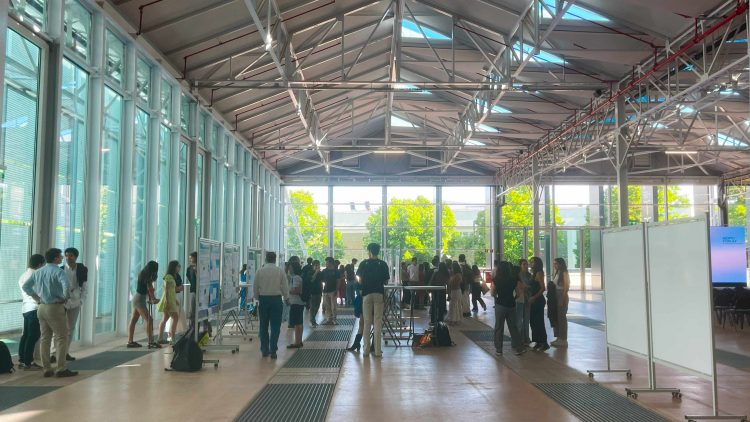
Each poster was assigned a number. Standing next to their project’s poster, Técnico students prepared for another public presentation of the 1st Cycle Integrative Projects (PIC), a curricular unit that challenges students to apply theory to address real-world challenges. On 9 June, the Técnico Innovation Center powered by Fidelidade, welcomed dozens of Biological Engineering and Biomedical Engineering undergraduate students for the second edition of the BioPIC Forum, an initiative organised by the Department of Bioengineering (DBE) at Técnico.
Joana Bicho was one of the students who presented her project, developed in collaboration with the Faculty of Human Kinetics and the Jamor High-Performance Sports Centre. The project sought to address an “everyday problem” identified in the assessment of vertical jumps and, to this end, the student created an automation tool integrated into software already used by the institutions, making the process faster and more personalised. “At the moment, we’re looking into whether we can get it implemented directly at the Jamor High-Performance Sports Centre. I’ve already tested the physical environment and, so far, everything has gone well”, she said.
Further ahead were Marta Câmara and Henrique Arraiol, both biomedical engineering students, who developed a project focused on explainable artificial intelligence algorithms for breast cancer detection by analysing data obtained through microwave technology. This approach enables future clinical decisions without the use of ionising radiation. “We’ve been working on this project for about five months. It’s good to be able to share a little of what we’ve been doing this past semester”, shared Henrique Arraiol.
In the second round of presentations, near poster 17, Maria Castanheira, Carolina Machado, Mariana Pereira and Acsa Freitas presented a pseudo-holographic 3D visualisation solution for orthopaedics. The project aims to improve communication between doctors and patients through low-cost 3D models that complement traditional 2D images, such as X-rays and CT scans. “Patients find it very difficult to understand their condition. It is important to develop new solutions that allow for a more intuitive visualisation of this anatomy and improve clinical communication”, explained Maria Castanheira.
For Nuno Mira, a professor at Técnico and coordinator of the curricular unit, the ‘conference’ format adopted addresses the challenges posed by the diversity of the projects developed by the students. “We wanted to involve professors with specific expertise in these areas, not only to provide students with a fairer assessment, but, above all, to offer more realistic and genuine feedback than we could provide ourselves, which is obviously limited in areas where we do not have such a strong grasp”, he explained.
Students were able to vote for their favourite project, which contributed to a small part of the final mark. “It was great to see that last year, the highest mark awarded by all the assessing professors coincided with the poster that the students identified as the best”, he explained. “The vast majority of our students are ready for this. It really sets us apart and allows students to engage with various real-world situations”, he added.
The session also included presentations by master’s students, featuring the work carried out by Gil Silva, Dinis Fernandes and Rodrigo Rosado, students attending the Master’s Programme in Bioengineering: Regenerative and Precision Medicine.
The group presented a ‘heart-on-a-chip’ model, developed from human cells, which can be used to study heart diseases and test potential treatments.
“It is interesting to note that at every level, they (the students) produce excellent work. It is very rewarding to assess them because they put in a great deal of effort and really get to the heart of the problem or scientific concept they are asked to develop”, said Tiago Fernandes, coordinator of the Master’s Programme in Bioengineering: Regenerative and Precision Medicine. As an assessor and supervisor of master’s projects, he highlighted the advantages of this model. “This format is very interesting because it is interactive, it is face-to-face, it encourages people to talk to one another and eases the burden of assessment, even if only symbolically”, he added.
Ana Azevedo, a professor at Técnico and coordinator of the Master’s Programme in Biological Engineering, also believes that this model “works very well”. “Generally, these topics are assigned to people with more expertise in the field. When each assessor has only eight projects to evaluate, the workload is lighter compared to when programme coordinators have to assess over a hundred”, explained the professor, who intends to adopt the model for the 2nd Cycle Integrative Project (PIC2).
During the afternoon, the event featured a presentation of the DBE’s Pedagogical Innovation Projects (PIP) and a panel discussion on Bioengineering, Health, Industry and National and European Funding, moderated by Professors Susana Vinga and Frederico Ferreira.
The roundtable discussion brought together Francisca Leite, Executive Director at Hospital da Luz; Marta Candeias, Head of Research and Innovation Projects Support Office at IST-ID; Paula Videira, Director of the i4HB Laboratory; and Tiago Matos, Assistant Professor at DBE, who reflected on the need to strengthen scientific solutions for societal impact.