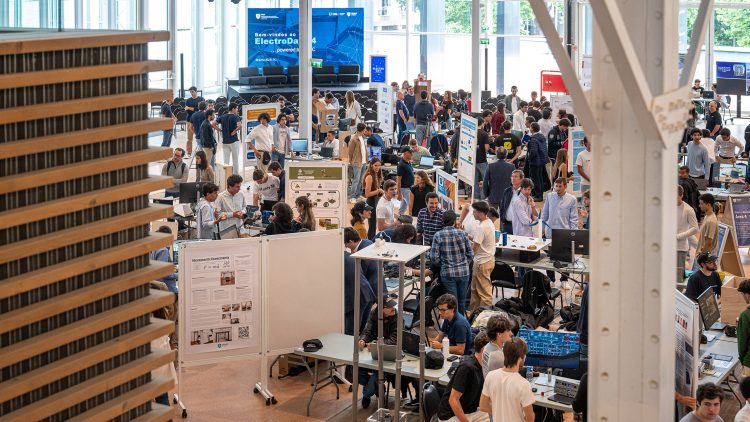
“It’s a day of celebration—we have more than 180 students here completing their first cycle of studies”. With the Técnico Innovation Center powered by Fidelidade filled with student project booths, Nuno Horta, head of the Department of Electrical and Computer Engineering at Instituto Superior Técnico, Universidade de Lisboa, set the tone for the start of the 2026 edition of ElectroDay. This annual event gives Electrical and Computer Engineering final-year students the opportunity to showcase their projects, as part of the ElectroCap programme, a teaching approach offered as part of the 1st Cycle Integrative Project curricular unit.
“Allowing students to build prototypes that showcase their solutions instead of just sticking to theoretical concepts is crucial”, confirms Luís Caldas de Oliveira, a professor at Técnico and member of ElectroDay’s organising committee. The importance of the event was later emphasised by Pedro Amaral, vice-president of Técnico for Corporate Interface, Innovation and Entrepreneurship, who stated that “I would like everyone to remember this event as a very positive moment in your time at Técnico”. For him, “being part of Técnico isn’t just about being part of the country’s largest engineering school (and perhaps one of the best in Europe and the world) – it’s also about creating memorable experiences”, like ElectroDay.
The main goal of the event is to empower students to apply the knowledge they’ve gained during their studies to address real-world challenges, thereby benefiting themselves, Técnico, and society as a whole.
As we explored the venue, it was clear that creativity and innovation were on display everywhere. One group showcased a waistband designed for workers exposed to harsh outdoor conditions – this device measures external temperature, humidity, and heart rate, while estimating the worker’s body temperature. It also emits audible and vibrating alerts when hazardous conditions are detected. Another group presented a self-contained solar-powered heater, ideal for environments where temperature regulation is crucial, such as in agriculture (greenhouses) or for preventing industrial systems from freezing (like fuel pipelines and battery storage facilities).
Further on, a patch of coloured lights demonstrated a wristband for medical emergency communication at music festivals. When activated, the wristband turns red and those nearby turn yellow, highlighting the area to which the medical team should proceed. Additionally, the wristband’s position can be triangulated using beacons located within the event venue and communicated to emergency teams via an app, along with the person’s medical records (provided they have given prior consent for this information to be shared in an emergency).
Técnico students even found inspiration within the concrete production process – as soon as it is laid on site, wet concrete begins to harden (in a process known as ‘concrete curing’), with the most significant changes taking place over the first 28 days. If this process is not properly monitored, the material may develop cracks during the curing phase, compromising both its quality and that of the structure. This process is usually carried out and monitored visually, so a group of students aimed to create a system for tracking three essential factors in this process – temperature, humidity and wind (which can cause the concrete to ‘dry out’ too quickly). They developed sensors to monitor how these variables change over time, issuing alerts and notifications at ‘critical points’ when intervention is necessary.
Awards presented at ElectroDay highlight the versatility of students’ ideas
As a result of a partnership with Jerónimo Martins and NOS, two prizes were awarded, each shared among three groups (one winner and two honourable mentions).
The Jerónimo Martins Academic Award for Communication Skills and ElectroCap Programme Impact was awarded to the Ignis project, with the CHAINGUARD and Lab In a Cube projects receiving honourable mentions. As for the NOS Academic Award for Best Demonstrator and Innovation in the ElectroCap Programme, honourable mentions went to the Crop Auditing and Orbis projects, with the Concrete Monitoring System taking top honours. Both awards also included a teaching support worth 2,670 euros, presented to the Department of Electrical and Computer Engineering.
The audience was also involved in selecting a third prize. Free registration for the event provided each visitor with a certain amount of ElectroCoins, a fictional currency that they could use to ‘invest’ in the most promising projects or those with the most effective presentations. The podium results, in ascending order of ElectroCoins, were as follows: Flare (73,000), Crop Auditing (111,000), and Ignis (137,000).
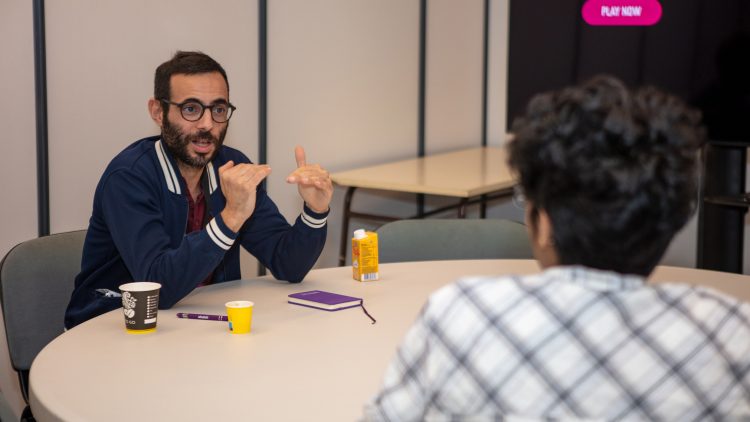
Filipe Marques points out that approximately 40 to 50 percent of the car’s development is credited to electrical and computer engineering students, stating, “without them, it wouldn’t run”. Although he is in his second year of the Undergraduate Programme in Aerospace Engineering, his involvement in the 2026 edition of ElectroDay is due to his membership in the Mobile Energy Sustainability Project (PSEM), a students’ organisation at Técnico where knowledge of electrical engineering is essential. Next to the GP23, the prototype brought to the Técnico Innovation Center that day, is the FST14, another prototype built by students from the Formula Student Técnico, FST Lisboa. Maria Cunha, a member of this group, confirms that in Formula Student, “it is also the electrical and computer engineering students who actually make the car move— in fact, the autonomous features are primarily developed by them”.
From the 32 groups and nearly two hundred Técnico students present, one thing is clear – if electrical and computer engineering students are the ones driving progress, as Filipe noted, the future that awaits these young people will certainly be dynamic. One might even say electrodynamic.
Awarded teams
- CHAINGUARD – Filipe Lavos, Francisco Motta, Francisco Mendonça, João Ferreira, José Guita, Vasco Oliveira;
- Concrete Monitoring System – Afonso Cristóvão, David Ferreira, Diogo Silva, Gonçalo Gonçalves, Gonçalo Carvalhal, José Batalha;
- Crop Auditing – Dyanne Freire, Filipe Ferrão, Gonçalo Martins, Maria Henriques, Rodrigo Barreiros, Tiago Rei;
- Flare – Augusto Fragoso, Guilherme Andrade, Margarida Amaral, Matilde Nunes, Pedro Gouveia;
- Ignis – Bárbara Trigueirão, Carolina Rodrigues, Diogo Vicente, Gonçalo Caetano, Marco Mendonça, Salvador Carvalho;
- Lab In a Cube – Cristina Wang, Lexin Weng, Lumi Pereira, Sara Pereira, Tiago Duanmu, Yaqi Xu;
- Orbis – Carolina João, Francisco Caravana, Margarida Sebastião, Matilde Silva, Tiago Carvalho, Tomás Ribeiro.